Clear path fouls, explained
Four conditions have to be true at once. Miss one and it is an ordinary foul instead of two shots and the ball.
- Section
- Explainers
- Desk
- Explainer
- Length
- 718 words, about 4 min
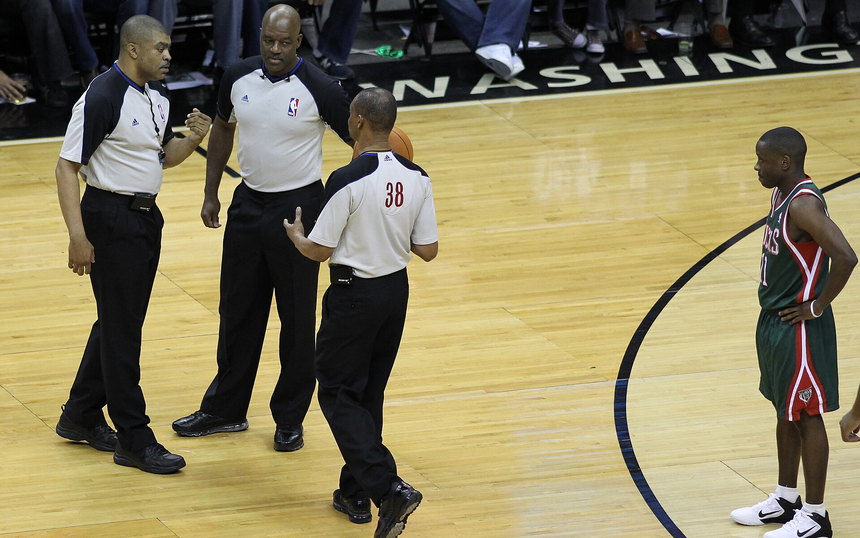
Under the NBA rulebook, a clear-path foul requires a personal foul committed during a transition scoring opportunity where the ball is ahead of the tip of the circle in the backcourt, no defender stands ahead of the offensive player, and the contact deprives the team of a scoring chance. The resulting penalty awards the offended team two free throws plus possession of the ball on the sideline nearest the spot where the foul occurred.
The call looks like an ordinary breakaway whistle on a television broadcast. The rule itself is narrow, precise, and built on spatial boundaries that referees must confirm before issuing one of the stiffer penalties in the rulebook.
The Five Required Conditions Under Rule 12
Rule 12 sets out five explicit elements that must be present at the moment of contact for a referee to assess a clear-path foul:
- The personal foul occurs on any offensive player during the team's transition scoring opportunity.
- The ball is located ahead of the tip of the circle in the backcourt.
- No defender is positioned ahead of the offensive player who has the transition scoring opportunity.
- The offensive player is in control of the basketball, or a pass to that player has already been released.
- The foul deprives the offensive team of its transition scoring opportunity.
If a play lacks any one of these elements, the clear-path standard fails. A foul committed while the ball is positioned inches behind the tip of the backcourt circle remains an ordinary foul. A play where a trailing defender manages to stay half a step ahead of the offensive player cannot be ruled clear path. Offensive control also carries strict timing: the passer must have released the ball, or the offensive runner must already hold it.
Actions That Void the Clear Path Ruling
Rule 12 explicitly carves out two scenarios where a clear-path foul cannot occur, regardless of how open the floor appears:
First, a clear-path foul cannot occur if the offensive player is fouled while in the act of shooting. When an attacker is already rising into a shot attempt, standard shooting foul rules apply, sending the shooter to the line for standard free throws without the added sideline possession.
Second, a clear-path foul cannot occur if the foul is caused by a defender's attempt to intercept or deflect a pass intended for the offensive player with the transition scoring opportunity. If a defender lunges across the passing lane to tip the ball away and makes illegal contact during that attempt, officials assess a common personal foul rather than a clear path.
The Sideline Penalty and Take Foul Precedence
When all criteria are met, the penalty is distinct: the offended team receives two free throws and possession on the sideline nearest the spot of the foul.
This penalty structure gives clear-path fouls priority over other transition calls on the floor. Under official NBA replay guidelines, a clear-path-to-the-basket foul takes precedence over a called transition take foul. If an official calls a take foul during a fast break, but the play meets the spatial requirements of a clear path, the clear-path ruling and its full two-shot-plus-possession award govern the restart.
The 2018 Simplification and Instant Replay Triggers
The current criteria reflect changes approved by the NBA Board of Governors for the 2018–19 season. That rule revision simplified the clear-path standard by stripping out judgment calls about whether a defender was between, or had the opportunity to be between, the offensive player and the rim.
Because evaluating ball position and defender spacing at full sprint is difficult, the league integrated the call into Rule 13 as an instant replay trigger. Referees are permitted to initiate a replay review whenever they are not reasonably certain whether a personal foul met the clear-path criteria.
During that replay review, officials evaluate four matters: whether the ball was ahead of the tip of the circle in the backcourt, whether no defender was ahead of the offensive player with the transition scoring opportunity, whether that player controlled the ball or had a pass released to him, and whether the foul deprived the offensive team of a transition scoring opportunity.